
Integrating GEO Strategy into Your Existing SEO Strategy
As if Search Engine Optimization (SEO) wasn’t difficult enough to understand the mechanics of, now Generative Engine Optimization (GEO) has started becoming an integral piece of the visibility puzzle. More and more humans are relying on generative engines to find information, and more and more brands are left wondering how they can start showing up in these searches. If you have no idea where to start, or even what GEO is, keep reading.
Quick Takeaways
SEO and GEO have similar strategies, but GEO prioritizes conversational and educational material with less conversion.
Organizations should take a look at the content they produce and what “funnel” that falls in.
From there, they should identify ways to tailor content creation to support GEO efforts.
Frequently Asked GEO Questions
What is GEO?
Whereas SEO is Search Engine Optimization, GEO is Generative Engine Optimization. Human behavior around “searching” is changing, and more and more people are relying on generative AI models to search. GEO takes into account how engine algorithms work and how users interact with them and turns that into a content strategy.
Why is GEO important?
In the past, 90% of searching on the internet went through Google. But now, AI models like ChatGPT, Copilot, Perplexity, Gemini, and Claude have taken shares in the search market. According to Sensor Tower’s State of AI Report 2026, as of May 2026, ChatGPT had over 1 billion users globally, making it the most popular chatbot. Gemini and Claude followed, with Gemini having 662 million users worldwide and Claude with 245 million users. All chatbots experienced continuous growth, signifying their increasing position in society.
How is GEO different from SEO?
Both GEO and SEO have similar best practices when you get into the fine details. However, the big-picture strategy differs. GEO takes into account conversational and “human-like” search patterns. It understands context and loves examples, data, and evidence it can use to output a rich, synthesized response, rather than a bunch of links.
Example
Let’s say you run a financial education site for creative solopreneurs. Say a potential audience member (an existing or potential solopreneur) wants to learn more about small business financing available to them.
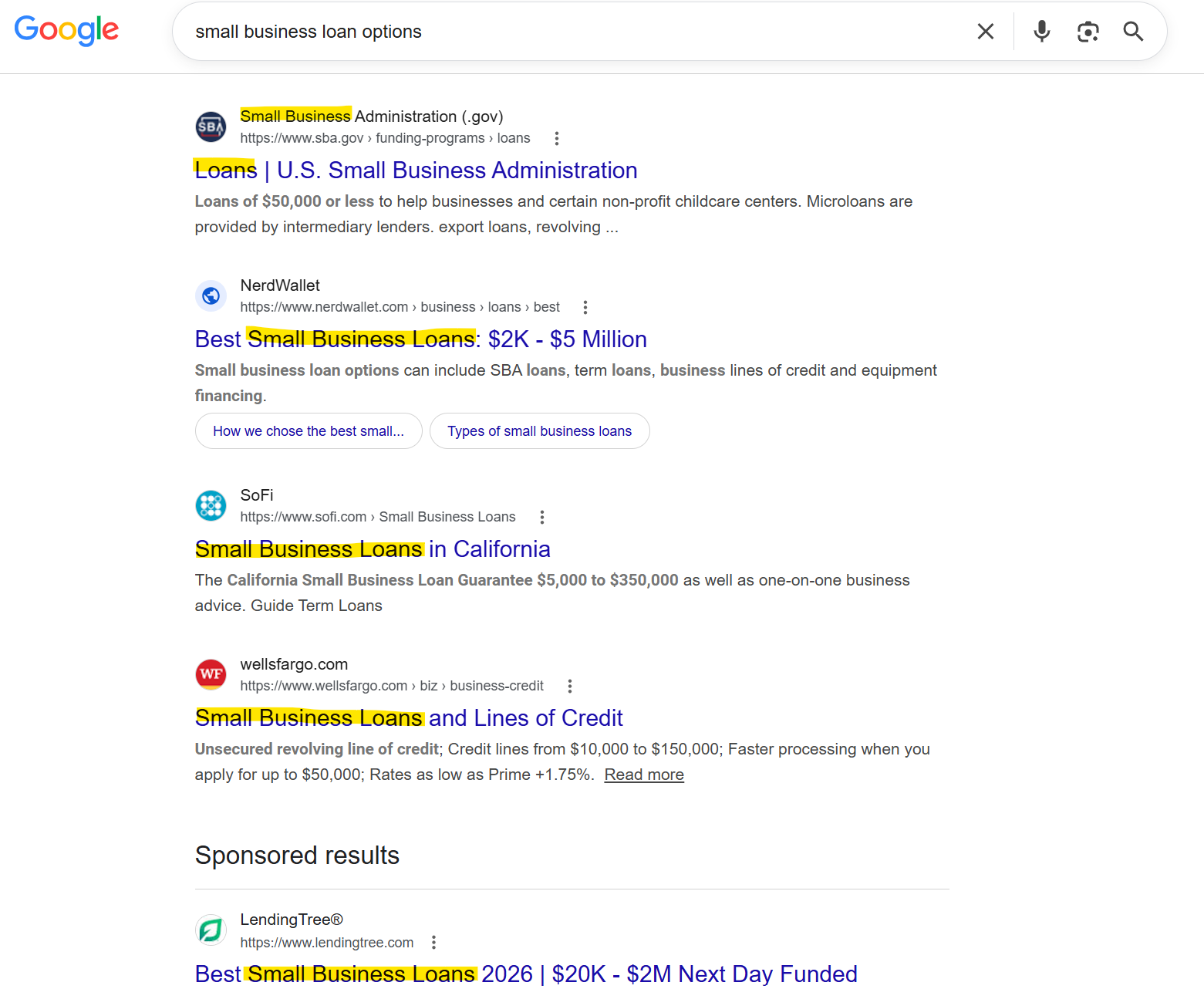
A traditional search (SEO) for "small business loan options" would surface a mix of highly trusted websites (those with strong domain authority) that use the keywords "small business" and "loan" as much as naturally possible. Local relevance often plays a role too, along with ad placements.
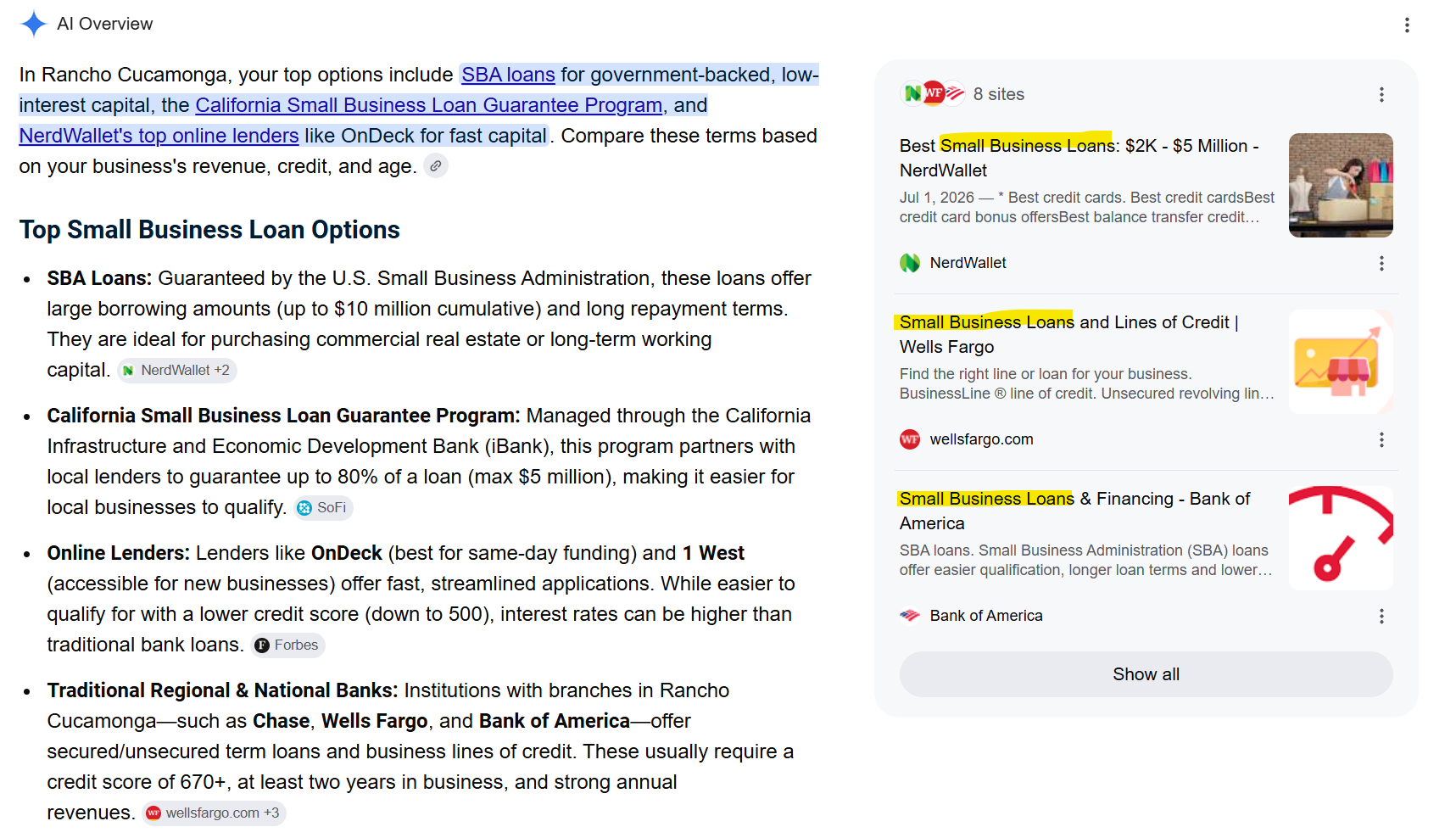
A generative search (GEO) for the same term works differently. The AI understands that a better experience than just presenting links and ads would be actual answers and options. It may cite some of the same sources SEO would surface, but it also opens the door to being featured in more contextual, specific placements. For example, a blog post that goes deep on a specific financing method (say, SBA microloans) could become a prime spot for visibility and citation, even if it would never rank on page one of Google.
Creating a GEO Content Strategy
Things to Keep in Mind
Google likes content that follows the EEAT acronym.
Experience
Expertise
Authoritativeness
Trustworthiness
This is what they use to rank quality content in terms of SEO. This still matters for GEO as well, as large language models follow similar algorithms. How you demonstrate this isn’t down to a formula, but there are general recommendations: AVOID keyword stuffing and instead TARGET a conversation your audience wants to have.
Just because you pop up in a generative search result, that doesn’t mean a “conversion” will happen. Someone might not care to click the link to the website or check out the reference where the information is from. GEO strategy right now is struggling with this “conversion” problem, where companies might get impressions but not conversions.
Because of this, it is important to create content for all stages of the content marketing funnel; that way you are getting impressions (which increase brand awareness) but also getting conversations (which allow you to reach KPIs)
The Funnel
There are three layers to a content marketing funnel. Content often blends across layers, which is why it helps to think in terms of GIA — Goal, Intent, Audience. Being clear on GIA helps you understand which layer of the funnel a piece of content is really targeting.
Top of Funnel (ToF): The widest part of the funnel, focused on building brand awareness. The goal here is to get your name associated with the questions, problems, or needs your audience has. This is the layer GEO strategy tends to reward most.
Typical ToF content could include the following:
High-level educational blog posts
Event recap posts
General social media content
Middle of Funnel (MoF): This is where trust gets built and the foundation for a conversion is laid. Someone already knows they have a need, but they just haven't picked a solution yet. In a B2B context, this looks like product specs or pricing pages.
Typical MoF content could include:
Third-party features or press mentions
Reviews (of a book, product, or service)
Newsletters
Events — even ones where most attendees are already familiar with you, since these can still convert newcomers or move existing supporters to a deeper level of engagement
Glossaries, guides, and other downloadable resources that differentiate you from competitors
Bottom of Funnel (BoF): This part of the funnel is the smallest because the people in this piece are the hardest to get. These are people who are interested in converting: becoming a sponsor, donating, being involved, volunteering, etc. For B2B companies, this is the end goal: sell my service or product to someone. For a nonprofit, it’s a bit different, but nevertheless, an important piece of the pie to consider.
Typical BoF content could include:
Testimonial videos or impact stories
Resource portals for existing supporters or customers
Detailed benefits table or pricing documents
Recommended Content Structure
Beyond following EEAT principles, strong GEO content tends to include a few recurring elements:
Long-form content (1,000+ words) performs well, though short-form still has value. A conversational, human tone is ideal either way.
Lead with the main idea. Put a clear summary or outline near the top — like a "TL;DR" — so both readers and AI models can quickly grasp what the piece covers.
Use real-world scenarios and examples rather than abstract claims.
Connect related concepts and keywords. For example, if you are the financial blogger writing about small business loans, link it naturally to a related topic, like revenue hurdles to overcome.
Build content "series." Recurring formats give both readers and search engines a reason to keep coming back.
Include context markers that help both LLMs and humans understand the situation your content addresses:
Explicit problem framing — a short narrative that grounds an abstract issue in a concrete situation.
Audience-based scenarios — describing a specific type of reader (e.g., "a first-time solopreneur registering a DBA").
Experience-level indicators — signals of firsthand expertise (e.g., "In 12 years of running this financial course, we've seen...").
Next Steps
To start building your own GEO strategy, work through these questions:
What questions, problems, or needs does my audience have? In other words, what do you want them typing into a search bar or asking an AI model that has your content showing up in response?
How do these questions map to keywords, both short and long-tail?
Example: a short keyword might be "project management tools," while a long-tail version might be "best project management tools for remote teams."
How does your existing or planned content need to shift to reflect these recommendations?